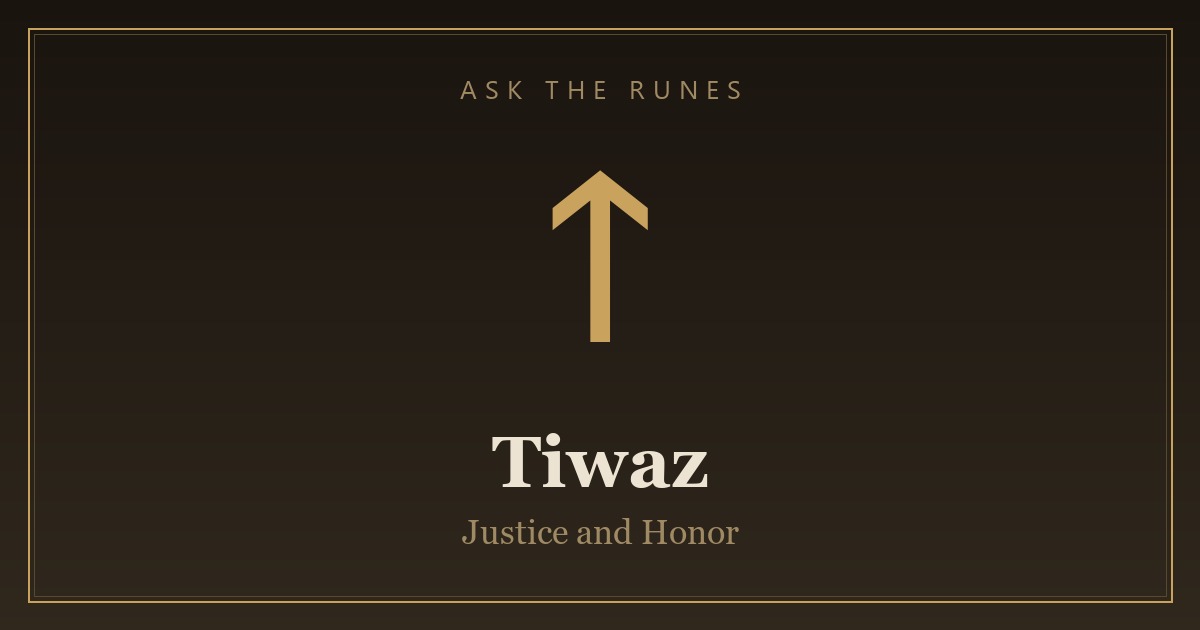
There is a rune shaped like an arrow pointing straight up, and it belongs to a god who gave his own hand to keep a promise. That rune is Tiwaz, and it does not deal in comfort. It asks the harder question: what are you willing to stand for, even when standing costs you something?
The Tiwaz rune meaning centers on justice, honor, courage, and self-sacrifice in a cause that is genuinely worth it. Named for Tyr, the Norse god of law and war, Tiwaz speaks to integrity under pressure, principled leadership, and victory earned the right way. It is the first rune of Tyr’s aett, the third and final group of eight in the Elder Futhark. If you want to see how it sits among all twenty-four staves, our rune meanings guide maps the full set.
When Tiwaz arrows into a reading, it rarely tells you to relax. It tells you to hold your line.
Tiwaz Rune at a Glance
| Attribute | Detail |
|---|---|
| Name | Tiwaz / Tiw / Tyr |
| Pronunciation | TEE-wahz |
| Symbol | ᛏ |
| Sound | /t/ |
| Aett | Tyr’s aett (third) |
| Deity | Tyr |
| Keywords | Justice, honor, courage, sacrifice, victory |
Keep this chart nearby as you read. An “aett” (say it “ett”) is simply one of the three groups of eight runes that make up the Elder Futhark, and Tiwaz opens the last one.
What the Tiwaz Rune Means (Upright)
Draw Tiwaz upright and the message is clear as a blade: you are being called to act with honor. This is the rune of the person who does the right thing when the easy thing is available and tempting.
The upright rune tiwaz carries a tight cluster of meanings. Justice and fair dealing. Courage under fire. Leadership that serves the people it leads rather than the ego of the leader. Self-discipline. And victory, though a specific kind of victory, the kind won through personal effort and sacrifice in a cause that deserves it.
Tyr rune energy is decisive and forward-moving, like the arrow it resembles. It favors strategy over brute force and principle over convenience. When you pull Tiwaz, you often already know what the honorable path is. The rune is confirming it, and quietly reminding you that knowing and doing are not the same thing.
There is a warmth underneath the steel, too. Tiwaz respects loyalty, duty, and keeping your word. It rewards the person who shows up, tells the truth, and finishes what they start. If you have been wondering whether to fight for something, Tiwaz upright tends to answer yes, provided the fight is just.
The Symbolism and Origins of Tiwaz
Look at the glyph. ᛏ is a single upright stroke topped with an arrowhead pointing to the sky, and that shape carries the whole story. It reads as a spear or an arrow aimed straight up, a symbol of directed will, honor held high, and a cause worth aiming at.
The rune takes its name and its spirit from Tyr, whom the Anglo-Saxons called Tiw. In the oldest layers of Germanic belief, Tyr was a sky god and the god of justice, law, and war conducted by rule rather than chaos. His most famous act is also his most painful.
The gods needed to bind Fenrir, a monstrous wolf whose strength grew by the day and threatened to devour the world. Fenrir suspected a trap and would only allow himself to be bound if one of the gods placed a hand in his jaws as a pledge of good faith. Tyr alone stepped forward. When the binding held and Fenrir realized he had been deceived, the wolf bit down, and Tyr lost his right hand, his sword hand.
That is the heart of Tiwaz. Tyr knew the cost, made the pledge anyway, and paid it so the greater good could be secured. He chose the sacrifice with open eyes, fully aware of what it would take from him.
The old Rune Poems reinforce the theme. The Anglo-Saxon and Norwegian verses tie Tir to a guiding star, praising it as a light that “keeps faith well” and holds its course over the mists of night without ever failing. Many scholars read this as the North Star, the fixed point sailors and warriors could always trust. That is the promise of Tiwaz: constancy, reliability, and faith kept even in the dark.
You may also encounter the “stacked Tiwaz,” the arrow drawn two or three times up a single stave. Practitioners have long used this repetition to amplify the rune’s force, calling on extra courage or a decisive victory. Treat it as intensification, not a different meaning.
Tiwaz Reversed and Merkstave Meaning
Turn Tiwaz upside down and the arrow points at the ground. The energy that drove upward now leaks away, and that reversal tells you where the trouble sits. In merkstave (the term for a rune’s shadow or “dark stave” position), Tiwaz warns that honor and direction have gone missing.
Reversed rune tiwaz can point to injustice, whether you are receiving it or, harder to admit, dishonoring someone yourself. It flags a loss of courage, motivation draining out, or a will to fight that has quietly collapsed. Ambition can stall here. A goal you chased with conviction now feels hollow, and you cannot say why.
Watch for a few specific patterns:
- Forcing an outcome through dominance or aggression rather than earning it
- Burnout from pouring effort into a cause that is not worth the fight
- Dishonesty, cut corners, or a compromise of your own integrity
- Imbalance, where drive has tipped into control or self-neglect
Tiwaz reversed holds up a mirror and asks honest questions. Is this fight actually yours? Are you standing firm or just being stubborn? Sometimes the courageous move is to lay the sword down and walk away from a battle that was never worth your blood. For more on how inverted staves shift a reading, see our guide to reversed rune meanings.
Tiwaz in Love and Relationships
In matters of the heart, Tiwaz upright reads as loyalty made visible. This is a rune of commitment, mutual respect, and partners who protect the relationship rather than compete inside it. When Tiwaz appears, it often marks a bond built on shared values and a willingness to put “us” ahead of “me” when it counts.
If you have been holding back from a hard, honest conversation, Tiwaz nudges you toward it. Speak your truth plainly and fairly. Relationships governed by this rune thrive on straight dealing and wither under games.
Reversed, the caution turns pointed. Tiwaz merkstave in love can signal one partner dominating the other, a fairness that has slipped, or courage failing right when honesty is needed most. It may reveal an imbalance of power or effort. The remedy is the same as the rune itself: choose fairness, soften the need to win, and rebuild the relationship on respect rather than control.
Tiwaz in Career, Money, and Health
At work, Tiwaz is one of the strongest allies you can draw. It favors leadership, disciplined strategy, and standing your ground in negotiations or disputes, especially when you genuinely have right on your side. This is the rune of the person who leads by example and earns respect rather than demanding it. In a legal or contractual matter, upright Tiwaz is an encouraging sign, provided your position is just.
For money, the message is earned progress. Tiwaz does not promise luck or a windfall. It promises reward for honest effort, discipline, and finishing what you began. Cut corners and the rune withdraws its favor fast.
On health, the warrior rune points toward strength, resilience, and recovery, particularly the willpower to push through a difficult stretch or heal after an injury. Reversed, watch for burnout, a body run past its limits, or courage spent on the wrong battle. Tiwaz here asks you to direct your strength wisely rather than simply spending it.
Tiwaz as Advice: Reading It in a Spread
When Tiwaz turns up in an advice or “action” position, read it as a call to stand firm with honor. It is asking you to lead, to keep your word, and to be willing to sacrifice something smaller for something that matters more.
Say you pull Tiwaz beside Uruz (strength) in a two-rune draw about a workplace conflict. I would read that pairing as a clear directive: you have the power for this fight, so use it justly and do not back down from what is fair. Now imagine Tiwaz reversed beside a rune of rest like Isa. That reads very differently, more like a warning that your courage is running on empty and the honorable move might be to pause before you break.
Context is everything. The runes surrounding Tiwaz tell you whether the sacrifice it asks for is worth making. If you are new to laying out and interpreting staves, our walkthrough on how to read runes shows you how to build a spread and let the runes speak to one another.
Tiwaz Rune FAQ
What does the Tiwaz rune mean?
The Tiwaz rune means justice, honor, courage, and self-sacrifice in a worthy cause. Named for Tyr, the Norse god of law and war, it points to principled leadership, integrity under pressure, and victory earned through effort rather than luck. Its upward arrow shape symbolizes directed will and standing firm for what is right.
Is Tiwaz a good rune to draw?
Upright, Tiwaz is a strong and encouraging rune. It signals courage, fairness, and success won honorably, and it favors legal matters and leadership when you have right on your side. Reversed, it turns cautionary, warning of lost motivation, injustice, or burnout. Like every rune, it reflects your situation rather than dictating your fate.
What does Tiwaz mean in love?
In love, upright Tiwaz means loyalty, mutual respect, and commitment built on shared values and honest dealing. It encourages you to have the fair, direct conversations a relationship needs. Reversed, it warns of imbalance, one partner dominating another, or courage failing when honesty matters most, and it calls you back toward fairness.
What is the arrow rune?
The arrow rune is a common nickname for Tiwaz (ᛏ), whose glyph looks like an arrow or spear pointing straight up. That upward point represents aim, honor, and directed will. Some practitioners draw a “stacked Tiwaz,” repeating the arrow up a single stave to amplify its energy for extra courage or victory.