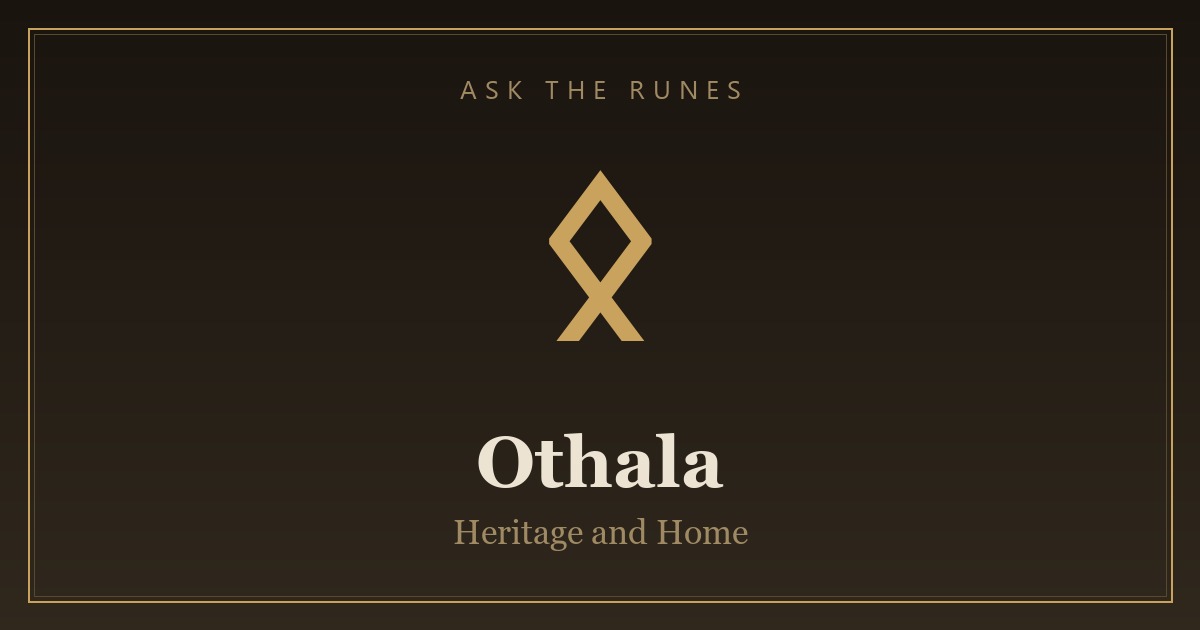
Every reading eventually circles back to a simple question: where do you come from, and what are you carrying forward? Othala is the rune that asks it directly. As the final rune of Tyr’s aett and of the Elder Futhark, it closes the whole cycle on a note of belonging.
The Othala rune meaning centers on heritage, ancestry, and inheritance. It speaks to the home you were given, the values handed down to you, and the legacy you will one day pass on. Where Fehu opened the Futhark with cattle and movable wealth, Othala ends it with the estate itself, the land that stays in the family and roots you to something larger than yourself.
This is a warm rune, and a demanding one. It asks you to look honestly at your roots, keep what nourishes you, and tend what you leave behind. For the full set, see the rune meanings guide.
Othala Rune at a Glance
| Attribute | Detail |
|---|---|
| Name | Othala (also Odal, Ethel) |
| Pronunciation | oh-THAH-lah |
| Symbol | ᛟ |
| Sound | /o/ |
| Aett | Tyr’s aett (the third and final group of eight) |
| Keywords | heritage, ancestry, inheritance, home, legacy |
An aett is simply one of the three groups of eight runes that make up the Elder Futhark. Othala sits at the very end of the third group, which makes it the twenty-fourth and last rune of the whole system.
What the Othala Rune Means (Upright)
Upright, Othala is the rune of belonging. It points to everything you inherit and everything that grounds you: your family, your home, your traditions, and the deeper sense of identity that comes from knowing your roots.
Its most literal meaning is the ancestral estate, the property and land held across generations. In a reading, that widens into any inheritance you carry. Often that inheritance is intangible: a skill your grandmother taught you, a value your parents lived by, a way of seeing the world that runs in your blood. Sometimes it is material, like a house, a family business, or money passed down.
Othala also carries a quiet sense of arrival. Because it stands at the close of the Futhark, many readers see it as the reward at the end of a long road, the stability you earn after the trials of the earlier runes. It suggests security, a place to stand, and the comfort of knowing where you belong.
When Othala appears, it often asks you to honor your foundations. What did you receive that still serves you? What tradition or family value is worth keeping alive? The rune invites you to build on what you were given, and to recognize that some of your strongest assets are the ones you did not have to earn.
There is a responsibility woven into that gift. What you inherit, you also steward. Othala reminds you that you are one link in a longer chain, holding something for a while before you hand it on.
The Symbolism and Origins of Othala
Picture a homestead: the family hall, the fields around it, the boundary that marks what belongs to the household. That is the image at the heart of Othala. Its name traces back to Proto-Germanic roots meaning ancestral property or homeland, and in Old English the rune became known as Ethel, again pointing to the estate or native land.
The Old English Rune Poem captures its warmth plainly. It describes an estate or home as dear to everyone, a place where a person can enjoy prosperity and what is rightfully theirs, in peace and comfort. That is the emotional core of the rune: the deep contentment of having a place that is truly yours.
The old sources also connect Othala to the ancestors themselves. In Norse and Germanic tradition, the family and the land were bound together, and the dead were not entirely gone. Some practitioners still work with Othala to honor lineage, to reflect on the traits and wisdom passed down through language, culture, and blood. Roots and legacy sit at the center of everything this rune touches.
It is worth being honest and clear about one part of Othala’s modern history. In the twentieth century, the rune was appropriated by Nazi and later white-supremacist movements, who twisted its meaning of “homeland” and “heritage” toward their own ideology. That association is a modern distortion, not an authentic part of the historical rune. The traditional Othala is about family, belonging, and what you pass on, and it has no genuine connection to those hateful ideologies. Naming this plainly lets us reclaim the rune for what it actually is.
Held in its true meaning, Othala is one of the most tender runes in the Futhark. It honors the people who came before you and asks what you will leave for the people who come after.
Othala Reversed and Merkstave Meaning
Not every inheritance is a blessing, and Othala reversed is where the rune turns its gaze on that truth. Merkstave, a term for the darker or “dark stave” reading of a rune, points to the shadow side of home and heritage. For the fuller framework, see reversed rune meanings.
Reversed, Othala can signal toxic inheritance: the prejudices, wounds, and generational patterns handed down alongside the good. Family trauma passes through the same channels as family wisdom, and this rune reversed asks you to notice what you have absorbed without choosing it. Some of what you inherited is worth keeping alive. The rest can safely end with you.
It can also point to family conflict, estrangement, or a home that no longer feels like a refuge. In its harsher forms, Othala reversed speaks to rootlessness, the ache of not belonging anywhere, or the literal loss of a home or property.
There is one more shadow worth naming. Othala reversed can warn against clinging rigidly to the past, mistaking “the way it has always been done” for the way it must be. Heritage becomes a cage when it hardens into prejudice or refuses to let anything grow. The rune asks you to stay rooted while still leaving room to grow.
Othala in Love and Relationships
In matters of the heart, Othala turns your attention to foundations. It often points to relationships built on shared values, family, and a sense of building something lasting together. This is the rune of the home you make with another person, the traditions you blend, and the roots you put down side by side.
Drawn upright in a love reading, Othala can signal a partnership that feels like belonging. It may highlight the role of family, whether that means blending two backgrounds, thinking about a shared home, or honoring where each of you comes from. It favors commitment, stability, and the quiet security of a relationship that has real ground under it.
Reversed, the rune can point to friction over family or values. Perhaps you and a partner come from very different worlds and struggle to find common ground. Perhaps old family patterns are playing out in the present, or a difference in what “home” means is creating distance. Othala reversed invites you to look at which inherited expectations are yours and which you have simply carried in without questioning.
Othala in Career, Money, and Health
Across work and money, Othala speaks the language of accumulated resources and foundations built to last. In career, it can point to work rooted in family, tradition, or a legacy you are building to last. A family business, a craft handed down, or a role where your background gives you a real edge all fall under this rune. It rewards patience and the steady building of something durable.
Financially, Othala is the rune of lasting assets: property, inheritance, savings, and the kind of wealth you tend across years. It encourages you to value what you already have and to build a legacy aligned with your principles. Reversed, it can warn of financial strain tied to property or family, disputes over inheritance, or a decline in something you assumed was secure.
In health, Othala often nods to the ancestral and the inherited. It can be a gentle prompt to consider family history and the patterns your body carries, and to draw on the grounding stability of home as a place of rest and recovery. Reversed, it may suggest that an inherited pattern needs attention, or that a lack of rootedness is quietly wearing you down.
Othala as Advice: Reading It in a Spread
When Othala turns up as guidance, read it as a call to look homeward. Ask yourself what you have inherited, in every sense, and whether you are tending it well. The rune’s advice usually points you homeward: recognize the foundation you already stand on, and build from there.
Say you pull Othala in the advice position of a three-rune spread about a career crossroads. Here it often nudges you toward the steady path: your background, your existing skills, the support of your family and community. The ground you already stand on is being highlighted for a reason.
Notice the runes around it, too. Beside a growth rune, Othala can mean building a lasting legacy. Beside a more difficult rune, it may be pointing to a family pattern that needs healing before you can move on. If you are still finding your footing with spreads, our guide on how to read runes walks through the basics step by step.
Above all, remember that Othala works like a mirror. It shows you your roots and your inheritance so you can decide, with clear eyes, what to keep and what to lay down.
Othala Rune FAQ
What does the Othala rune mean?
Othala means heritage, ancestry, and inheritance. As the final rune of the Elder Futhark, it represents the ancestral home or estate, family, tradition, and the legacy you carry and pass on. Upright, it points to belonging, stability, and the foundations that ground you.
What does Othala mean reversed?
Reversed, Othala points to the shadow side of home and heritage. It can signal toxic inheritance, generational trauma, family conflict, rootlessness, or the loss of a home. It also warns against clinging rigidly to tradition or letting inherited prejudice go unexamined.
What does Othala mean in a family reading?
In a family reading, Othala speaks directly to lineage, roots, and the values passed between generations. Upright, it highlights strong foundations and belonging. Reversed, it can surface inherited patterns, old wounds, or conflicts that are worth healing rather than repeating.
Why is Othala associated with heritage?
Othala’s name traces to Proto-Germanic and Old English words for the ancestral estate and homeland. In the old tradition, family and land were bound together, so the rune came to hold everything you inherit, from property and traditions to the deeper identity carried in your blood.