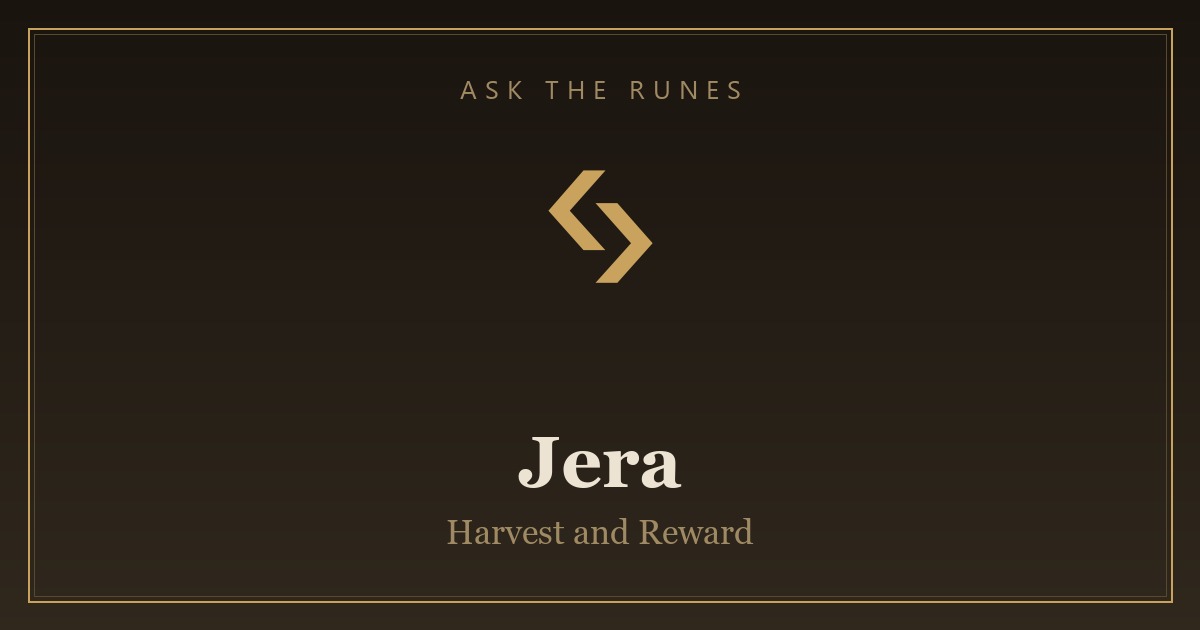
Some runes crackle with urgency. Jera is not one of them. This is the rune of the slow yield, the patient season, the reward that arrives right when it is ready and never a moment before. When Jera turns up in a reading, it rarely tells you to act faster. More often it asks a quieter question: what have you been tending, and is it time to gather it in yet?
The Jera rune meaning centers on harvest, natural cycles, and the reward that comes from patient effort over time. As one of the runes of Heimdall’s aett in the Elder Futhark, it sits among the runes of transformation and change. You can see the full set on our rune meanings guide, but Jera deserves a slow read of its own, because its lesson runs against almost everything modern life trains us to want.
Jera Rune at a Glance
| Attribute | Detail |
|---|---|
| Name | Jera (also Ger, Jara) |
| Pronunciation | YEH-rah |
| Symbol | ᛃ |
| Sound | /j/, like the y in “year” |
| Aett | Heimdall’s aett (the second) |
| Keywords | Harvest, cycles, reward, patience, natural timing |
What the Jera Rune Means (Upright)
Jera means “year,” and in the old agricultural world a year meant one thing above all: the harvest. A good harvest, specifically, the kind of season that fed rich and poor alike through the cold months. That is the heart of this rune, the reward you earn by working with time instead of fighting it.
When Jera appears upright, it usually brings good news, though of a specific kind. Picture fruit ripening on a tree you planted seasons ago rather than a sudden windfall dropping from the sky. The effort is already behind you, and Jera confirms it paid off. The return is on its way, or already ripening as you read this.
The rune carries a strong note of cause and effect. You reap what you sow, plainly and without drama. If you have sown steadily, Jera promises a fair yield. If you have been distracted or half-hearted, it invites you to look honestly at what your current fields actually hold.
Patience is the quiet backbone of every Jera reading. The rune asks you to trust the timing of things. Some results simply cannot be rushed, and forcing them early spoils the crop. Jera reminds you that a slow season is still a moving one, always carrying you toward the yield.
The Symbolism and Origins of Jera
The name Jera comes from a Proto-Germanic root meaning “year” or “good season,” and it is the same root that eventually gave English the word “year” itself. In the runic worldview, a year was not an abstract number on a calendar. It was a felt cycle of sowing, tending, waiting, and reaping.
Look at the glyph ᛃ and you see two separate shapes that seem to turn around each other. Practitioners often read them as the two halves of the year, light and dark, summer and winter, locked in an endless dance. Neither half wins. Each gives way to the other in turn, and the turning itself is the point. Growth and rest are partners, not rivals.
The Old English Rune Poem captures Jera (there called Ger) with warm simplicity. It describes summer as a joy, the season when God allows the earth to bring forth its bright fruits for rich and poor alike. That last phrase matters. The harvest here belongs to everyone, a shared good, a season of plenty that reaches across the whole community.
This is why Jera feels so grounded compared to flashier runes. It is rooted in the oldest human bargain of all, the one between people and the land. You prepare the soil, you plant, you wait through weather you cannot control, and in time the earth answers. That bargain is honest, and Jera carries its honesty.
Why Jera Has No Reversed Meaning
Some runes change meaning when they fall upside down, a reversed position practitioners call merkstave. You can read more about that in our guide to reversed rune meanings. Jera is not one of those runes.
Turn Jera upside down and you get Jera again. The glyph is symmetrical, so it has no distinct reversed form. This is more than a technicality. It reflects the rune’s very nature. Cycles have no true reverse, since winter and summer are two halves of one turning wheel, each giving way to the other. The wheel keeps turning either way.
So Jera is never read as merkstave. That does not mean it is always effortless good fortune, though. When Jera lands in a challenging position, or beside difficult runes, it takes on a shadow tone worth reading carefully.
That shadow usually speaks of timing gone wrong. Sometimes it points to impatience, the urge to harvest a field that is not ripe or to abandon a project just before it would have paid off. Acting too soon here is its own kind of failure. Other times the shadow is a delayed harvest, a season where the reward you expected is simply not due yet. The work was sound, but the calendar is not finished. Jera in a hard spot asks you to check which of these you are facing before you make a move.
Jera in Love and Relationships
In matters of the heart, Jera is a patient and encouraging rune. It speaks of relationships that grow the way good things grow, gradually, through tended seasons rather than instant fireworks. If you have weathered a hard stretch together, Jera often signals that the effort is about to bear fruit.
For couples, Jera can mark the turning of a difficult season into an easier one. The arguments that took real work to move through, the compromises made and remade, the slow building of trust, all of it starts to pay off. Lasting change tends to arrive quietly, and Jera honors that quiet.
If you are single, Jera counsels patience over pursuit. The right connection tends to ripen in its own time, and chasing it too hard can bruise the fruit. Keep tending your own ground, the friendships and the self-knowledge, and trust that the season will turn.
Jera also invites reflection on what you have planted in your closest bonds. Warmth, honesty, and steady attention return a harvest. Neglect returns a thin one. The rune is gentle, but it does not pretend that love grows without care.
Jera in Career, Money, and Health
For work and money, Jera is one of the most reassuring runes to draw, provided you have put in the groundwork. It signals that long effort is about to be rewarded. Projects reach completion, recognition arrives, and the accounts you have patiently built begin to yield.
Jera rarely promises a shortcut. Instead it promises fairness. The raise, the launch, the milestone you have been grinding toward is coming into season. Your job now is to keep tending it and to resist the temptation to abandon the work right before it ripens. Many people quit one season too early. Jera asks you not to be one of them.
On finances, the rune leans toward slow, cyclical growth rather than a jackpot. Think savings that compound, investments that mature, debts steadily cleared. Jera rewards the tortoise, not the hare. It also gently reminds you that lean seasons are natural and will pass, so plan across the whole year rather than a single month.
For health, Jera speaks the language of recovery and rhythm. Healing follows its own timeline and cannot be forced. Rest, consistency, and honoring the body’s natural cycles do more than any frantic push. If you have been patient with a recovery, Jera suggests the turn toward wellness is underway.
Jera as Advice: Reading It in a Spread
When Jera falls in the advice or outcome position of a spread, read it as a nudge toward patience and trust in timing. It is telling you the work is largely done and the harvest is coming, so do not uproot the crop to check the roots.
Consider a small worked example. Say you draw Jera in the outcome position of a three-rune spread about a stalled creative project, with Nauthiz (need, constraint) in the present. Together they suggest that the current friction is not failure but the necessary tending before a yield. The advice reads clearly: keep going through the hard part, because Jera says the season will turn. For more on building and interpreting layouts like this, see how to read runes.
Notice, too, which runes sit beside Jera. Because the rune is about cycles, its neighbors tell you whether you are at the sowing point or the reaping point. Jera beside beginnings leans toward planting. Jera beside completions leans toward gathering in.
Jera Rune FAQ
What does the Jera rune mean?
Jera means “year” or “harvest,” and it represents cycles, natural timing, and the reward that comes from patient, sustained effort. It is the rune of reaping what you have sown, of results arriving in their own good time rather than on demand.
Is Jera a good rune?
Yes, Jera is generally a very positive rune. It signals fruition, fair reward, and the turning of a hard season into an abundant one. Its only caution is about timing: it asks you to be patient and not to harvest before the crop is ripe.
Can Jera be reversed?
No. Jera is a symmetrical rune, so it looks the same upside down and has no reversed or merkstave meaning. In a difficult position it can take on a shadow of impatience or delayed reward, but it is never read as a true reversal.
What does Jera mean in a reading?
In a reading, Jera usually points to effort about to pay off and encourages patience with natural timing. Look at the surrounding runes to tell whether you are at a moment of sowing or of harvest, since both are part of Jera’s cycle.