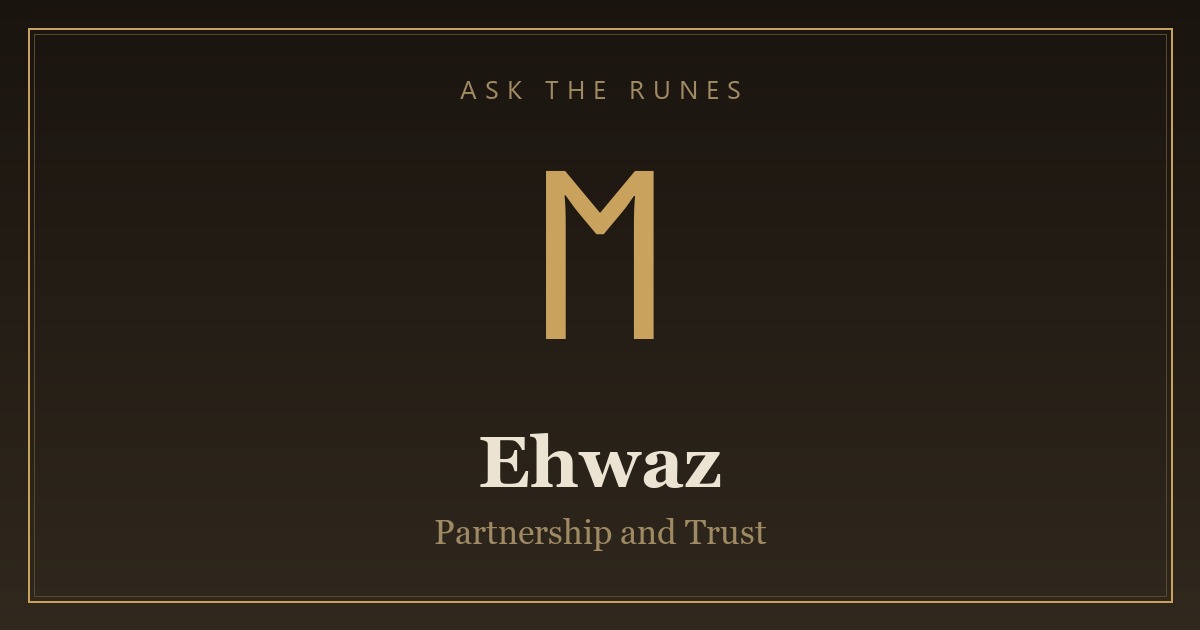
Picture a rider and a horse who have traveled a thousand miles together. The rider barely needs the reins anymore. A shift in weight, a quiet word, and the horse already knows. That closeness, built over time and tested on hard roads, is the heart of Ehwaz.
The Ehwaz rune meaning centers on the bond between horse and rider: partnership, trust, and steady forward motion built on cooperation. This is the nineteenth rune of the Elder Futhark and a member of Tyr’s aett, the third of the three families (aett is the Old Norse word for a group of eight runes). Where some runes speak of solo effort, Ehwaz speaks of what two beings can do when they move as one. You can find the whole set on our rune meanings guide, but for now, let’s stay with the horse.
Ehwaz Rune at a Glance
Here is the quick reference before we go deeper. Keep it beside you if you are casting tonight.
| Attribute | Detail |
|---|---|
| Name | Ehwaz (also Eh) |
| Pronunciation | EH-wahz |
| Symbol | ᛖ |
| Sound | /e/ (as in “get”) |
| Aett | Tyr’s aett (third family) |
| Association | The horse |
| Keywords | Partnership, trust, movement, loyalty, progress |
What the Ehwaz Rune Means (Upright)
When Ehwaz turns up in a reading, it usually points to a relationship that carries you forward. The horse does not run for itself. It runs with a rider, toward a destination the two of them share. That image tells you almost everything about how this rune behaves in a spread.
Upright, Ehwaz is a good omen for teamwork. It speaks of two people, or a person and a cause, moving in the same direction with trust between them. Business partners who finish each other’s thoughts. A marriage where both people are pulling toward the same horizon. A friendship steady enough that you would let it carry you somewhere unfamiliar. The rune asks whether you have a companion for the road ahead, and whether you trust that companion enough to loosen your grip.
Movement is the other half of the message. Ehwaz often signals progress that feels smooth rather than forced. You are not stalled, and you are not sprinting past your own limits. You are covering ground at a pace you can sustain. In practical terms, the rune can even hint at literal travel, a change of place, or a new vehicle for your ambitions.
There is a note of loyalty here too. A horse gives its strength to its rider and trusts that the rider will care for it in return. When Ehwaz appears, it can be reminding you that partnership is a two-way promise. Whatever ally is carrying you now deserves your attention and your gratitude.
The Symbolism and Origins of Ehwaz
The name Ehwaz simply means horse, and in the Norse world that was no small thing. Horses were sacred animals. They carried warriors into battle, hauled the dead to their rest, and appeared in rites of divination where a priest might read the future in a stallion’s movements. To own a good horse was to hold sovereignty, mobility, and a thread to the otherworld all at once.
Look at the glyph, ᛖ, and you can see the story written into it. Many readers describe two upright staves joined by a crossing line, like two horses standing head to head, or a horse and rider fused into a single shape. That visual union is the whole point. Ehwaz is about the moment two become one working thing, where you can no longer easily say where one ends and the other begins.
Norse myth gives the rune its most famous face in Sleipnir, Odin’s eight-legged steed. Sleipnir carried the god between the worlds, across boundaries no ordinary creature could cross. That gives Ehwaz a quieter, deeper layer beneath the everyday meaning of partnership. The right bond can take you places you could never reach alone, including inner places.
The Old English Rune Poem keeps things grounded and warm. It calls the horse a joy to princes, a steed proud in its hoofs, and a comfort to the restless when wealthy riders exchange talk about it. Read that again and notice what it praises. Not raw power alone, but the pride, the companionship, and the ease the horse brings to those who travel and gather. The old poets understood that a horse was worth celebrating because of the life it made possible with its people.
Ehwaz Reversed and Merkstave Meaning
Turn Ehwaz over and the partnership loses its rhythm. In its reversed or merkstave position (merkstave means the “dark stave” or shadow reading of a rune), Ehwaz points to a bond that has fallen out of sync.
The most common message is distrust. The horse and rider are no longer reading each other. That might show up as a partnership where the two people want different things, a marriage strained by poor communication, or a working relationship where one person feels they are doing all the pulling. Something that once moved smoothly now bucks and resists.
Reversed Ehwaz can also mean a stalled journey. You feel the urge to move but the road is blocked, or the timing is simply wrong. Restlessness sets in. In its harsher readings, the rune can even whisper of betrayal or a mismatch that was there from the start, an alliance built on hope rather than real trust.
The advice hidden in the reversal is usually patience. When every sign says stop, forcing the horse forward only frightens it. Wait for the right moment, tend to the relationship, and rebuild the trust before you ask it to carry weight again. You can read more about how upside-down runes shift a spread in our guide to reversed rune meanings.
Ehwaz in Love and Relationships
Few runes speak to relationships as directly as this one. Ehwaz is fundamentally a rune of two beings choosing to move through life together, so it lands with real weight in any reading about love.
Upright, it is one of the warmer signs you can draw for a partnership. It suggests mutual understanding, shared goals, and a couple who function as a team rather than two people negotiating from opposite sides. For someone asking about commitment, Ehwaz often reads as a green light. It favors marriage and long partnerships because those are exactly the kind of bonds it describes, ones that deepen through miles traveled side by side.
The rune also rewards effort. A horse and rider earn their closeness through practice, patience, and countless ordinary days. If Ehwaz appears when you are building something new with a person, take it as encouragement to keep showing up. Trust here is not a spark. It is a habit.
Reversed, the tone shifts toward friction. Ehwaz upside down can point to a couple growing distant, missing each other’s signals, or wanting different destinations. It rarely spells doom on its own. More often it asks you to slow down, talk honestly, and check whether you are still riding toward the same place.
Ehwaz in Career, Money, and Health
In work and money questions, Ehwaz keeps its focus on cooperation and steady motion. Upright, it often signals a strong partnership or a team clicking into place. A business alliance, a mentor who carries you toward opportunity, or a project advancing at a healthy clip all fit its energy. If you have been weighing whether to join forces with someone, this rune leans toward yes, provided the trust is real.
Progress under Ehwaz tends to be incremental. Small consistent steps that add up, rather than a sudden windfall. For finances, that can mean gains built through patience and good partnerships instead of a lucky gamble. The rune favors the tortoise’s steadiness even while it wears the horse’s speed.
For health, Ehwaz carries a gentle, encouraging note. It can signal recovery that is underway, momentum returning to a body that felt stuck, or the value of moving in step with a trusted guide, whether that is a doctor, a healer, or a supportive companion. Reversed, it may hint at burnout from pushing too hard, or the need to rest and restore trust in your own body before charging ahead.
Ehwaz as Advice: Reading It in a Spread
When you pull Ehwaz as guidance, the rune is usually asking about your companions on the road. Who or what is carrying you right now, and are you tending that bond as well as it tends you?
Say you draw Ehwaz in the “advice” position of a three-rune spread about a career move. I would read it as a nudge to lean on partnership rather than go it alone. The right ally, the right team, the right steady pace will get you further than sheer force. It might also be pointing to the trust you need to build before the journey can begin. Look at the runes around it. Ehwaz tends to strengthen its neighbors, coloring the whole reading with cooperation and forward motion.
If you are still learning to interpret positions and combinations, our walkthrough on how to read runes covers the spreads and the casting basics step by step.
Ehwaz Rune FAQ
What does the Ehwaz rune mean?
Ehwaz means horse, and in a reading it represents partnership, trust, and steady forward movement. It draws on the bond between a horse and its rider, two beings working as one toward a shared destination. Upright, it favors teamwork, loyalty, marriage, and smooth progress. It is one of the most relationship-focused runes in the Elder Futhark.
Is Ehwaz a good rune to draw?
Upright, Ehwaz is generally a very positive rune. It signals cooperation, trust, and progress you can sustain, which makes it welcome in questions about love, work, and travel. Reversed, it warns of distrust, poor timing, or a partnership out of sync. Even then it offers hope, since most rifts it describes can be mended with patience.
What is the difference between Ehwaz and Raido?
Both runes involve movement, but they emphasize different things. Raido is the rune of the journey itself, the road, the ride, and the rhythm of travel. Ehwaz is the horse that carries you and the trust between horse and rider. Where Raido asks about your path, Ehwaz asks about your companion and the partnership that moves you along it.
How is Ehwaz connected to Norse mythology?
Ehwaz links most famously to Sleipnir, Odin’s eight-legged steed who carried the god across the boundaries between worlds. Horses were sacred in Norse culture, tied to sovereignty, fertility, and divination. This gives Ehwaz a deeper layer beneath everyday partnership. The right bond can carry you to places, outer and inner, that you could never reach alone.