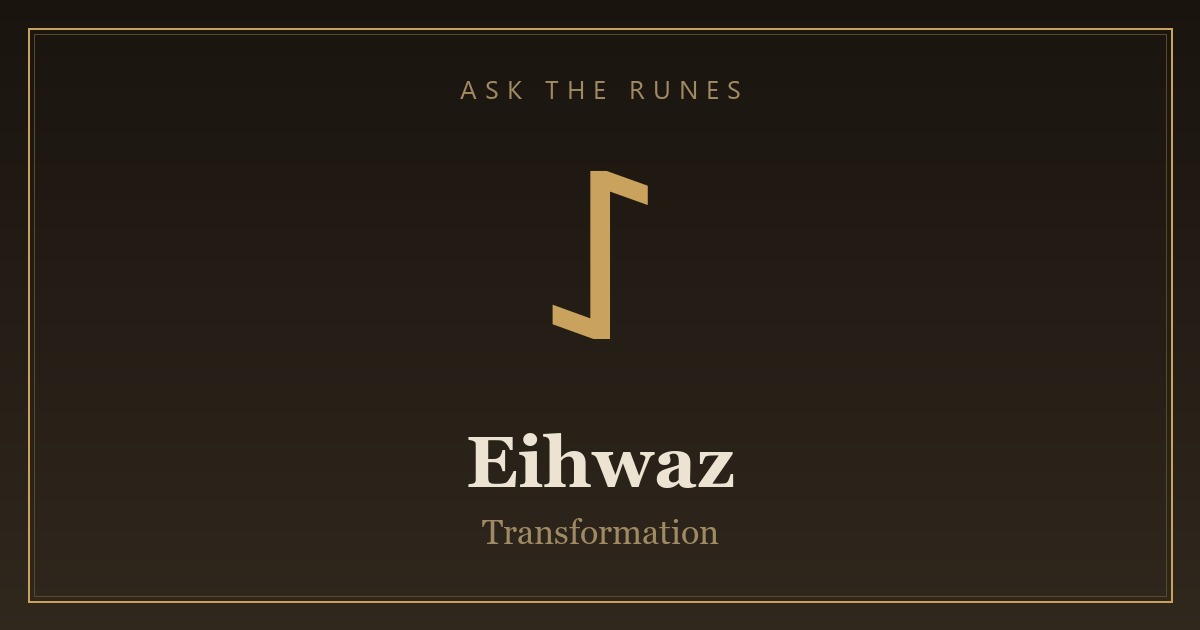
Some runes arrive gently. Eihwaz is not one of them. It shows up when something in your life is ending so that something else can begin, and it asks you to stay standing while that happens. The Eihwaz rune meaning turns on a single ancient image: the yew tree, evergreen through winter, rooted so deep it seems to touch the dead and the living at once. As the thirteenth rune of Heimdall’s aett in the Elder Futhark, Eihwaz sits at the heart of the row, a spine holding the whole thing upright. If you want to see how it relates to the other twenty-three, the full set lives in our rune meanings guide.
This is a rune of endurance and passage. It does not promise the change will be easy. It promises you have the backbone to walk through it.
Eihwaz Rune at a Glance
| Attribute | Detail |
|---|---|
| Name | Eihwaz (also Eoh, Yr) |
| Pronunciation | AY-wahz |
| Symbol | ᛇ |
| Sound | /ei/ (a special e/i sound) |
| Aett | Heimdall’s (the second aett) |
| Association | The yew tree, Yggdrasil |
| Keywords | Endurance, transformation, death and rebirth, protection, transition |
Keep this table beside you when Eihwaz turns up in a cast. The name shifts across traditions, but the tree stays constant, and the tree is the whole point.
What the Eihwaz Rune Means (Upright)
When Eihwaz appears, you are standing at a threshold. Something is asking to be released, and the rune’s answer is not to cling but to endure the crossing. It often marks the big transitions of a life: a move, a marriage, a career change, a retirement, the slow letting-go of a version of yourself you have outgrown.
The feeling it carries is intensity without panic. Change of this size can feel like too much, and Eihwaz does not pretend otherwise. What it offers instead is steadiness. The yew survives the hardest winters by staying green when everything around it goes bare, and that is the posture the rune asks of you. Hold your ground. Let the season turn.
There is protection woven into this rune as well. The yew was planted in graveyards and beside sacred sites for a reason, and Eihwaz brings some of that guardian quality into a reading. When you are moving between two chapters, the space between can feel exposed. Eihwaz says you are not walking it unguarded.
Read it as reflection, not a fixed verdict. The rune shows you a passage that wants to happen. Whether you meet it with resolve or with resistance is the part that stays in your hands.
The Symbolism and Origins of Eihwaz
The yew is one of the longest-lived trees on earth. Some are thought to be thousands of years old, hollowing out at the center while new growth carries on around the shell. That single fact holds most of what Eihwaz means. The tree is both extremely old and endlessly renewing, dead in the middle and alive at the edges, which is exactly the paradox of death and rebirth the rune keeps pointing at.
In Norse cosmology the yew becomes the world-tree, Yggdrasil, the axis that runs through all the worlds and binds them together. (Ash is the more common name for Yggdrasil, though several old sources describe an evergreen, and the yew fits that picture.) Picture a trunk that reaches from the roots in the underworld up through the world of the living and into the realm of the gods. That vertical line is Eihwaz: the connection between realms, the spine of the cosmos, the path a soul travels between one state and the next.
This is why the rune carries the weight of initiation. To pass along that axis is to be changed by the journey. Old rune-workers linked Eihwaz to the kind of transformation that strips away what is weak so that what remains can stand. Think of the Death card in tarot, which almost never means literal death and almost always means an ending that clears the ground.
The Old English Rune Poem, where the rune is called Eoh, gives a grounded portrait. It describes the yew as a tree with rough bark, hard and fast in the earth, held firm by its roots, a keeper of fire and a joy on the estate. Every line is about reliability. Rough on the outside, immovable below, useful and even glad to have around. That is the tree, and that is the temperament Eihwaz lends to whoever draws it.
Why Eihwaz Has No Reversed Meaning
Look at the glyph. ᛇ is symmetrical along its length, so turning it upside down gives you the same shape back. Because of that, Eihwaz has no reversed or merkstave form. Some runes flip into a shadow meaning when they land upside down in a spread. Eihwaz simply cannot, and you should never invent a reversed reading for it. If you want the fuller picture of which runes reverse and which do not, see our guide to reversed rune meanings.
That does not make Eihwaz all light. A rune can still speak in a harder voice depending on where it falls and what surrounds it. When Eihwaz lands in a difficult position, read it as a transition you are resisting. The ending has already announced itself, and some part of you is bracing against it, gripping the old shape long after it stopped serving you.
The shadow of the yew is a fear of endings. It is the refusal to let a chapter close, the way we sometimes keep watering a plant that finished its season. In that key, Eihwaz is not punishing you. It is naming the place where you are stuck and inviting you to loosen your hold.
Eihwaz in Love and Relationships
In matters of the heart, Eihwaz usually points to a relationship moving into a new phase. That might be moving in together, deciding to marry, or navigating the quieter shift when two people grow and have to grow toward each other rather than apart. The change can feel unsettling before it feels good.
If you are in a partnership, the rune asks for endurance and honesty in equal measure. Some transitions in love are uncomfortable precisely because they are real, and Eihwaz favors the couple willing to face a hard conversation over the couple that keeps the peace by saying nothing. Deep insecurities sometimes surface here. Meeting them together is how the bond deepens.
If you are single, Eihwaz can mark the end of an old pattern in how you love. Maybe a way of choosing partners, or of protecting yourself, has run its course. The rune supports letting that die so a truer version of you can show up next time.
Eihwaz in Career, Money, and Health
For work and money, Eihwaz reads as a threshold and a test of your staying power. A role is ending, a field is shifting, or a long effort is finally turning a corner. The counsel is to accept the change with resolve and stay flexible while it moves. Rigidity snaps in a storm. The yew bends and holds.
Financially, this is rarely a rune of sudden windfall. It rewards the long game, the discipline of staying rooted while conditions change around you. If you have been building something slowly, Eihwaz is a good omen for endurance paying off.
On health, the rune connects to the spine and the core, both literally and as a metaphor for what holds you up. It can flag the need for backbone, for resilience through a demanding stretch, or for the quiet renewal that follows a hard season. As with every rune, this is reflection rather than diagnosis. Real concerns belong with a real practitioner.
Eihwaz as Advice: Reading It in a Spread
When Eihwaz falls in the advice or outcome position, it is telling you to endure the passage rather than escape it. Say you draw it in a three-rune spread over a career question, sitting in the future position beside a rune of new beginnings. I would read that as a threshold you cannot skip: the fresh start is real, but only on the far side of an ending you have been putting off.
Notice what the rune sits next to. Beside supportive runes, Eihwaz reads as protected passage. Beside harder ones, it leans toward the resisted-transition shadow, the ground where you are holding on too tightly. New to casting, or want a refresher on positions and how neighboring runes color each other? Start with our walkthrough on how to read runes.
Eihwaz Rune FAQ
Is Eihwaz a good rune to draw?
Eihwaz is neither purely good nor bad. It marks a necessary transition and lends you the endurance to make it. Most readers welcome it, because it signals real growth and a measure of protection through the change.
Can Eihwaz be reversed?
No. The glyph ᛇ is symmetrical, so it has no reversed or merkstave form. In a hard position it reads as a transition you are resisting rather than as a separate inverted meaning.
What does the yew tree have to do with Eihwaz?
The yew is the rune’s namesake and its whole symbolism. Evergreen, ancient, and rooted deep, the yew represents endurance and the cycle of death and rebirth, and it stands in for Yggdrasil, the world-tree that connects all realms.
What is Eihwaz asking me to do?
To stay standing through an ending and let a new phase begin. Rather than clinging to what is closing, meet the transition with a steady backbone and trust that you are held while you cross.