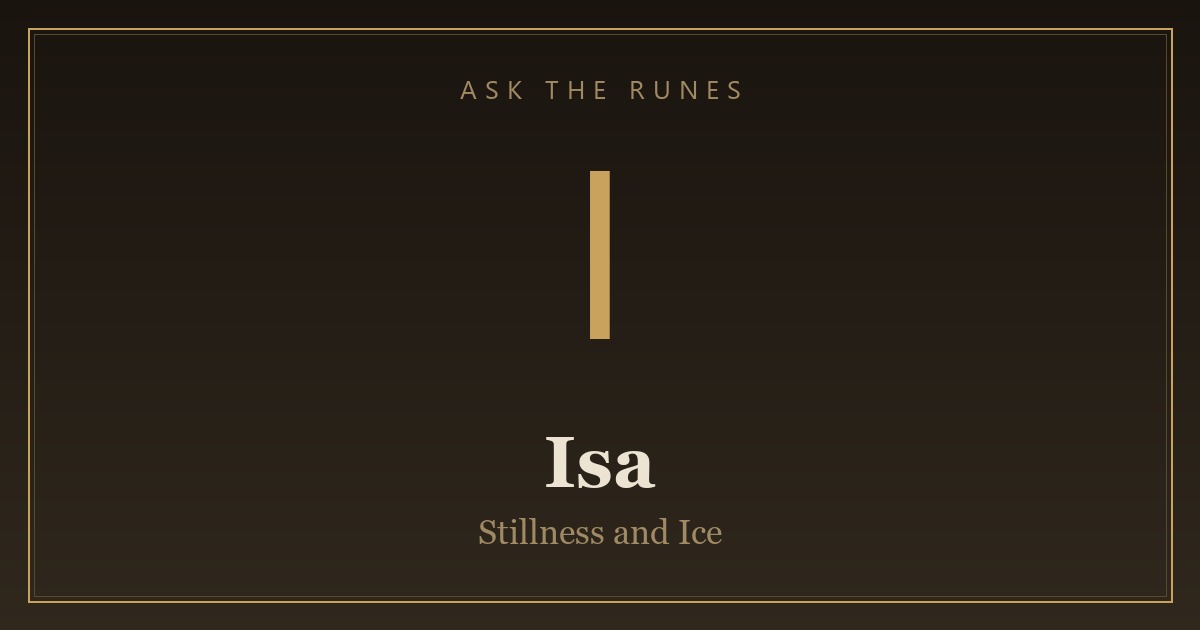
Some runes arrive urging you forward. Isa asks you to stop. Pronounced “EE-sah,” this is the rune of ice, and it carries the strange, glassy quiet of a lake frozen solid overnight. The Isa rune meaning centers on stillness, stasis, and the pause that comes before anything can move again. It is the eleventh rune, the first stave of Heimdall’s aett in the Elder Futhark, and it looks exactly like what it describes: a single vertical line, spare and upright as an icicle.
When Isa turns up in a spread, it rarely means disaster. More often it means wait. There is a season for pushing and a season for holding still, and this rune points squarely at the second one. If you want to see how it sits beside the other twenty-three staves, the full rune meanings guide lays them all out. For now, let’s sit with the ice.
Isa Rune at a Glance
| Attribute | Detail |
|---|---|
| Name | Isa / Isaz / Is |
| Pronunciation | EE-sah |
| Symbol | ᛁ |
| Sound | /i/ (as in “ee”) |
| Aett | Heimdall’s (second aett) |
| Association | Ice |
| Keywords | Stillness, pause, patience, stasis, introspection |
What the Isa Rune Means (Upright)
Isa is a held breath. It marks a moment when the current of your life has slowed to a crawl, and the honest reading is that this slowdown is doing something useful, even if you can’t yet see what.
Think of what ice actually does. It stops motion. It preserves whatever it locks in place. A frozen pond is water waiting, and everything beneath the surface stays exactly where it was when the cold set in. That is the energy Isa brings to a reading. Potential is being held for you, and nothing is being taken away. It is simply on pause.
For the person drawing it, the practical message is patience. This is not the week to force a decision, launch the big thing, or demand an answer from someone who isn’t ready to give one. Isa asks you to gather information, rest, and let clarity come the way it comes on a still winter morning, slowly and all at once. Some of the sharpest insights arrive only when we stop stirring the water long enough for it to settle.
There is real self-control in this rune too. Isa is the discipline to wait when everything in you wants to act. Read warmly, it says: the freeze is temporary, and you’re being given time you didn’t know you needed.
The Symbolism and Origins of Isa (Ice, the Frozen Pause, the Rune Poem)
In Norse cosmology, ice is elemental. It belongs to the very beginning of things. The old creation story begins with the meeting of primordial ice from Niflheim and fire from Muspelheim, and from that collision the world takes shape. Isa carries a fingerprint of that beginning. It is the elemental force that holds form, the counterweight to fire’s restless motion.
The single vertical stroke is the whole point. Where most runes are built from several lines leaning and crossing, Isa is one clean stave, an “I” standing alone. Some readers call it the seed rune, the line from which the others could be drawn. It is the rune of the self, the “I am” you return to when everything outside you has gone quiet.
The Old English Rune Poem gives Isa (as “Is”) its most vivid portrait. Ice, it says, is very cold and slippery beyond measure. It glistens clear as glass and gleams like gems. It is a floor made by the frost, and it is fair to look upon. That description holds the rune’s whole character. Ice is beautiful. Ice is also treacherous underfoot, and the same frozen surface that dazzles you can drop you if you trust it carelessly. Isa is both the shine and the slip.
That double nature is worth keeping close. The stillness Isa brings can be a gift or a trap, depending on how long you stay in it and how honestly you read the ground beneath your feet.
Why Isa Has No Reversed Meaning
Most runes can be cast reversed, and that flipped position (called merkstave, roughly “dark stave”) shifts the meaning toward its shadow. Isa can’t do this. Turn a single vertical line upside down and you get the same single vertical line. The rune is perfectly symmetrical, so it reads the same no matter how it falls. It has no reversed form at all.
That doesn’t mean Isa is always gentle. A rune with no merkstave still has a shadow, and Isa’s shadow shows up through position and context rather than through inversion. When it lands in a challenging spot in a spread, or beside difficult runes, the ice can read as ice that has stayed too long.
Here is what that harder Isa can point to:
- Frozen too long. A pause that was meant to be a rest has hardened into being stuck. The waiting has become avoidance.
- Emotional coldness. Distance that has curdled into shutting down, in yourself or in someone close to you.
- Stubbornness and rigidity. Isa’s love of stability tipping over into refusing to change even when change is clearly needed.
The skill in reading Isa is telling a healthy pause from a harmful freeze. If you want a broader sense of how inverted staves work across the set, the guide to reversed rune meanings covers the runes that do flip. Isa simply asks a different question: is this stillness serving you, or has it started to numb you?
Isa in Love and Relationships
In matters of the heart, Isa usually signals a cooling. Not a breakup, and not the end of feeling, but a stretch of quiet where the warmth pulls back and both people retreat into themselves for a while.
Sometimes that is exactly what a relationship needs. Two people who have been tangled up in each other’s daily orbit occasionally need room to remember who they are on their own. Isa can mark that healthy space, the pause where a bond settles and deepens out of sight, the way roots keep growing under frozen ground.
Read less kindly, Isa in a love reading can point to a partnership that has gone cold and stayed there. Conversations that have frozen mid-sentence. Affection that has iced over into routine or silence. If the surrounding runes lean that way, Isa is asking you to notice the chill honestly rather than pretend the water’s still flowing.
For someone waiting on a new connection, Isa counsels patience. The timing isn’t ripe yet. Pushing now is like walking out onto thin ice, and the wiser move is to let the season turn.
Isa in Career, Money, and Health
Draw Isa for work or money and the message is a familiar one by now: hold. Projects stall. Decisions hang unmade. The promotion, the payment, the answer you’ve been waiting on all seem locked behind a door that won’t open on your schedule.
Frustrating, yes. But Isa reframes the delay as preparation. A frozen field in winter is not a failed field, it is a resting one, and it will grow again come spring. Use this stalled stretch to firm up your foundations. Clarify what you actually want. Finish the quiet groundwork that gets skipped when things move fast. Balance the books, tidy the plan, sharpen the tools.
With money specifically, Isa often warns against big moves. This is a season to conserve rather than gamble, to let reserves sit rather than pour them into something that hasn’t taken shape yet.
For health, Isa reads as a call for rest. Genuine rest, the kind that lets a tired body and an overworked mind actually recover. It can also nudge you to slow down enough to notice what you’ve been ignoring. Stillness here is medicine, not a setback, as long as it doesn’t harden into isolation or a refusal to move when it’s finally time.
Isa as Advice: Reading It in a Spread
When Isa lands in the advice position, its counsel is short and clear: be still, and pay attention.
Picture a three-rune past-present-future draw, with Isa sitting in the present. I read that as a snapshot of someone caught mid-freeze, and my first question is always the same. What is this pause protecting? Look to the rune on either side. A growth rune before Isa suggests a natural rest after effort. A conflict rune after it hints that the stillness is buying you time to see clearly before you act.
The move Isa asks for is almost never “do more.” It is “wait, watch, and gather yourself.” When I cast Isa, I read it as a pause, not a punishment. For a fuller walkthrough of casting and laying out spreads, see how to read runes.
Isa Rune FAQ
Is the Isa rune positive or negative?
Neither on its own. Isa is a rune of pause, and whether that pause helps or hinders depends on the reading and on you. Most often it points to a necessary, restorative stillness rather than a loss.
Does Isa have a reversed meaning?
No. Isa is a single vertical line and is perfectly symmetrical, so it looks identical upright or upside down. It has no reversed or merkstave form. Its shadow, things like being frozen too long or emotionally shut down, shows through its position in the spread.
What element is the Isa rune associated with?
Ice. In Norse cosmology ice is one of the two primordial forces, alongside fire, and Isa carries that elemental weight as the principle of stillness and held form.
What should I do when I draw Isa?
Wait, and watch. Resist the urge to force a decision or push a stalled situation. Use the quiet to rest, gather information, and let clarity settle before you move again.