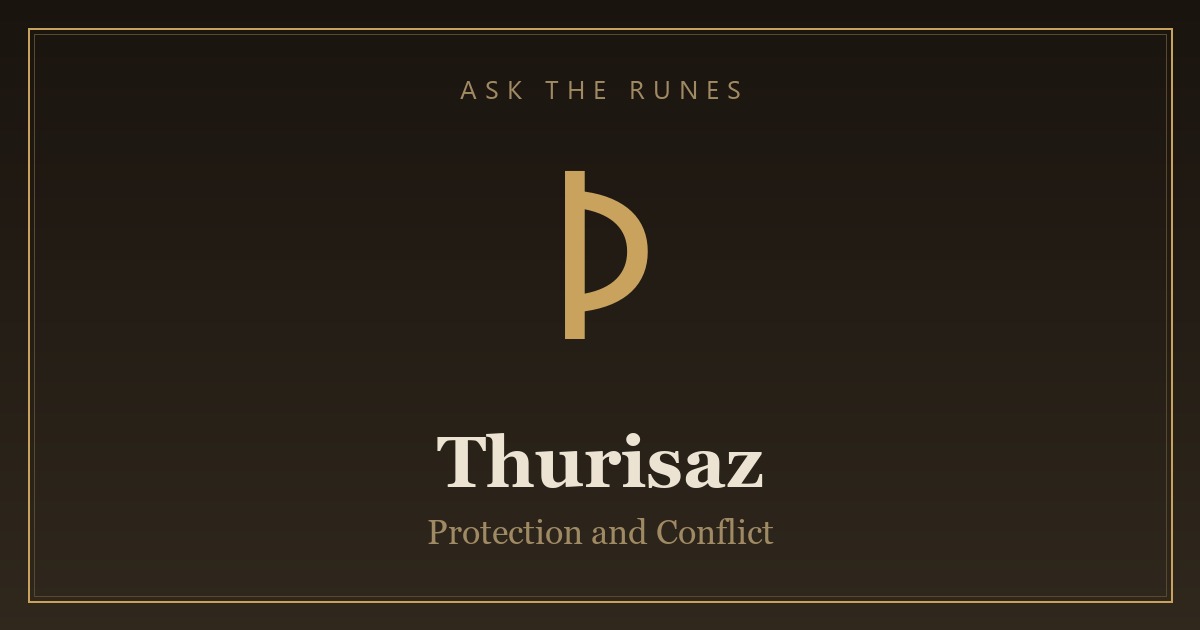
Some runes settle you. Thurisaz wakes you up. It arrives with a jolt, the way a thorn reminds your finger that the rose has boundaries. The Thurisaz rune meaning centers on reactive force: a raw, defensive power that can protect you or wound you depending on where it points. This is the third rune of Freyr’s aett in the Elder Futhark, and it has a reputation for being difficult. That reputation is only half the story.
Yes, Thurisaz carries conflict, friction, and the untamed strength of the giants. But friction is also how a spark is made. When this rune lands in your reading, it rarely means doom. More often it means a turning point, a decision, or a force you can learn to aim. Runes are a mirror, not a verdict, and Thurisaz shows you exactly where the pressure lives. You can see the full set on our rune meanings guide, and here we go deep on the thorn.
Thurisaz Rune at a Glance
Before the depth, here is the quick reference to keep beside your cast.
| Attribute | Detail |
|---|---|
| Name | Thurisaz / Thurs / Thorn |
| Pronunciation | THUR-ee-sahz |
| Symbol | ᚦ |
| Sound | /th/ (the “th” in “thorn”) |
| Aett | Freyr’s aett (the first aett) |
| Association | Thor, the giants (thurs) |
| Keywords | conflict, defense, catalyst, reactive force, gateway |
The glyph itself tells the story. A single vertical stave with a sharp triangular point jutting from its side, ᚦ looks like exactly what its name says: a thorn on a branch. Simple, and a little dangerous to touch.
What the Thurisaz Rune Means (Upright)
Pull Thurisaz upright and you have drawn a rune of raw, directed power. This is the energy that clears the ground so something new can grow. It can feel abrupt, because it often marks the moment a situation stops simmering and finally breaks open.
Think of the rune thurisaz as a catalyst. It is the argument that finally names what has gone unsaid, the deadline that forces a decision, the boundary you set after months of quiet resentment. None of that feels comfortable while it happens. All of it moves you forward.
Upright, this rune asks you to meet a challenge instead of avoiding it. It favors courage over hesitation and clarity over drift. When you stand your ground and act with purpose, the same force that felt threatening becomes protection, a thorn turned outward to guard what matters to you.
There is a cleansing quality here too. Thurisaz can burn off old patterns, stale agreements, and situations you have outgrown. The discomfort is the point. A splinter has to come out before the skin can heal, and this rune is often the tweezers.
Just remember the core lesson of the thorn rune: raw power is neutral until you aim it. The same strength that defends can also destroy. Thurisaz upright is a green light to act, paired with a quiet warning to act with intention rather than reflex.
The Symbolism and Origins of Thurisaz
The name Thurisaz carries two images at once, and both matter. It means “giant,” specifically the thurs, the wild and chaotic giants of Norse cosmology who stood in eternal opposition to the ordered world of the gods. It also means “thorn,” the sharp point that draws blood from a careless hand.
Hold those two ideas together and you understand the rune. The giants represent primal, untamed force, the kind of power that existed before order and does not care about your plans. The thorn represents that same force made small and personal, a sharp reminder of danger you can feel in your own skin.
Then there is Thor. The thunder god is the great counterweight to the giants, and his hammer Mjolnir meets their chaos and gives it shape. This is the heart of Thurisaz. The rune holds the raw force of the thurs and, in the same breath, the disciplined strike that channels that force toward protection. Thor himself carries giant blood, which tells you everything you need to know. That wild power is raw material for anyone willing to shape it.
The old Rune Poems refuse to soften this. The Norwegian poem warns that “thurs causes anguish to women,” and the Icelandic tradition links the thurs to sickness and torment. The Anglo-Saxon poem turns to the thorn instead, describing it as sharp to every warrior who grasps it, harmful to anyone who rests among thorns. These verses were never written to comfort anyone. They stay honest about the sting.
For modern practice, that honesty is a gift. Thurisaz does not pretend that growth is painless. It names the thorn, hands you Thor’s hammer, and asks what you intend to do with the force in your hands.
Thurisaz Reversed and Merkstave Meaning
When Thurisaz falls reversed, or shows up in a hard “merkstave” position (merkstave means “dark stave,” the shadow or ill-omened reading of a rune), the protective thorn turns inward. Instead of defending you, the force works against you. You can read more about how inversions shift a cast in our guide to reversed rune meanings.
Reversed, this rune often points to defenselessness, a moment when you feel exposed, overwhelmed, or unable to push back. The strength that should guard you has drained away, and a real threat may be closer than you would like.
It can also warn of ill-considered action. This is force with no aim behind it: lashing out, reacting from anger, making the ill-timed move you will regret. Where upright Thurisaz strikes with purpose, reversed Thurisaz strikes blind and often wounds the wrong target, sometimes yourself.
Watch for spite, stubbornness, and the refusal to deal with a problem that keeps growing. Merkstave Thurisaz frequently describes the trouble you avoided until it doubled in size. The medicine is the same one the upright rune offered, just harder to swallow now: face the thing directly, aim your energy, and stop letting the thorn point back at you.
Thurisaz in Love and Relationships
In matters of the heart, Thurisaz is rarely subtle. It tends to surface when there is friction that has been building under the surface, the kind couples circle for weeks without naming.
Drawn upright, this rune often signals a necessary confrontation. Not a breakup by default, but a real conversation, the one where you finally say the true thing. Handled with clear communication and a cool head, that clash can clear the air and bring you closer. Thurisaz favors honesty over politeness that quietly rots.
The rune also speaks to passion and intensity, the vital charge between two people. That heat is a resource. Aimed well, it deepens intimacy. Aimed carelessly, it becomes the fight that leaves marks.
Reversed in a love reading, Thurisaz warns of conflict that has turned destructive: spite, defensiveness, or one partner feeling unprotected and unheard. Take it as a prompt to act. The rune is showing you where the pressure sits so you can tend it before the thorn does the talking.
Thurisaz in Career, Money, and Health
At work, Thurisaz is the rune of the make-or-break moment. It often marks a challenge you cannot sidestep: a demanding project, a clash with a colleague, a decision that forces your hand. Meet it with directed effort and it becomes the breakthrough. Avoid it and it hardens into the obstacle that blocks everything behind it.
This rune rewards decisive, disciplined action over drift. If you have been waiting for the perfect moment, Thurisaz is the nudge to strike now, with intention, rather than let the opportunity pass.
With money, the thorn rune asks for care around reactive choices. Impulse spending, a rash financial move, or a deal pushed through in anger can all cut you. The upright message is to channel your drive into a clear, defended plan. The reversed message is to slow down before a hasty decision does damage.
For health, Thurisaz often points to raw vital energy and the body’s fight-or-flight response. It can flag stress, tension, or anger that needs a healthy outlet before it turns inward. Treat this as reflection rather than diagnosis. If a reading raises a real concern about your body, the wise move is always to speak with a medical professional, not a rune.
Thurisaz as Advice: Reading It in a Spread
When Thurisaz shows up in an advice position, read it as a call to act with aimed force. This is no invitation to recklessness. Stop avoiding the confrontation, the boundary, or the decision you already know is due.
Picture a three-card past-present-future cast where Thurisaz sits in the present, flanked by Uruz (strength) behind it and Raidho (the journey, movement) ahead. That line reads clearly: you have the raw power, a catalyst has arrived, and the way forward opens once you engage it. The thorn is not blocking your path. It is the gate you walk through.
Always weigh Thurisaz against its neighbors and the question you asked. Beside a gentle rune it may soften into simple assertiveness. Beside harsher staves it may warn of a real clash to prepare for. If you are still building your cast-reading instincts, our walkthrough on how to read runes shows you how to let the runes speak to each other rather than in isolation.
Thurisaz Rune FAQ
What does the Thurisaz rune mean?
Thurisaz means reactive force, conflict, and defense. It is the third rune of Freyr’s aett in the Elder Futhark, tied to the giants (thurs) and to Thor’s hammer. Upright, it signals a catalyst or turning point, raw power you can aim toward protection or breakthrough when you act with clear intention.
Is Thurisaz a bad rune?
No. Thurisaz has a difficult reputation, but it is a catalyst, not a curse. It often marks a necessary confrontation or a moment of decisive change that moves you forward. Reversed, it warns of ill-aimed action or feeling defenseless, yet even then it functions as a mirror, showing you where to focus rather than sealing your fate.
What does Thurisaz mean in love?
In love, Thurisaz usually points to friction that needs naming, a necessary and honest conversation. Handled with clear communication, that clash can clear the air and deepen intimacy. Reversed, it warns of conflict turning spiteful or a partner feeling unprotected, a prompt to tend the tension before it grows.
What is the thorn rune?
The thorn rune is another name for Thurisaz, whose name means both “giant” and “thorn.” Its glyph ᚦ looks like a thorn on a vertical branch. The image captures the rune’s nature: a sharp, defensive point that guards what matters when turned outward and wounds when turned the wrong way.